The shadows of the pickers grow longer as they move slowly through the late afternoon woodland, alive with vibrant shades of orange, umber and gold. Nadine Jeannier and her daughter, Coline Léger, kick through the fallen leaves, bending repeatedly to carefully pluck rich brown treasures out of spiky shells. Sweet chestnuts carpet the forest floor and the women fill their buckets again and again, each picking up to 100 kg a day. Nadine pauses to stretch her back and looks up at the tree above. “See the scar there, on its trunk? This tree must be 400 years old, it was grafted by a farmer all that time ago. It is only thanks to their care that we gather such large, tasty chestnuts today.”
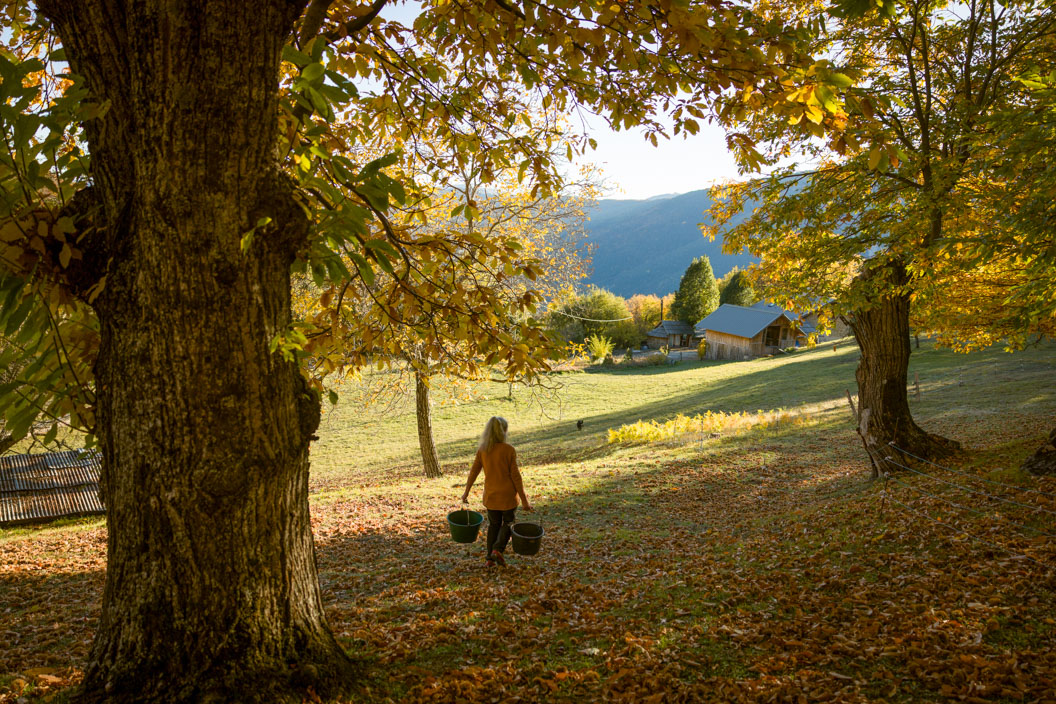
Nadine Jeannier winds up a day’s chestnut picking on her farm
Nadine and her family are castanéiculteurs (chestnut producers). They cultivate 100 trees, in the way that generations before them did, above the valley of Annot in the Alpes-de-Haute-Provence. Yet their own story is recent. Sweet chestnuts had all but disappeared here until recently. Nadine, initially a novice, led an inspiring community project to revive local chestnut groves.
Sweet chestnuts: ancient pickings
From Corsica to the Cévennes, sweet chestnut trees have provided food for humans and animals for millennia. The fruits of the châtaignier, native to southern Europe, have lost none of their appeal. 8,000 tonnes of sweet chestnuts were produced in France in 2024. They boast a delicious, nutty taste when roasted, and offer a nutritional calorific bomb with which to enter winter. What heavily-loaded Christmas table is complete without the added weight of chestnuts? What could be a more sociable ritual à la Française than sitting around an open fire, grilling and eating them?
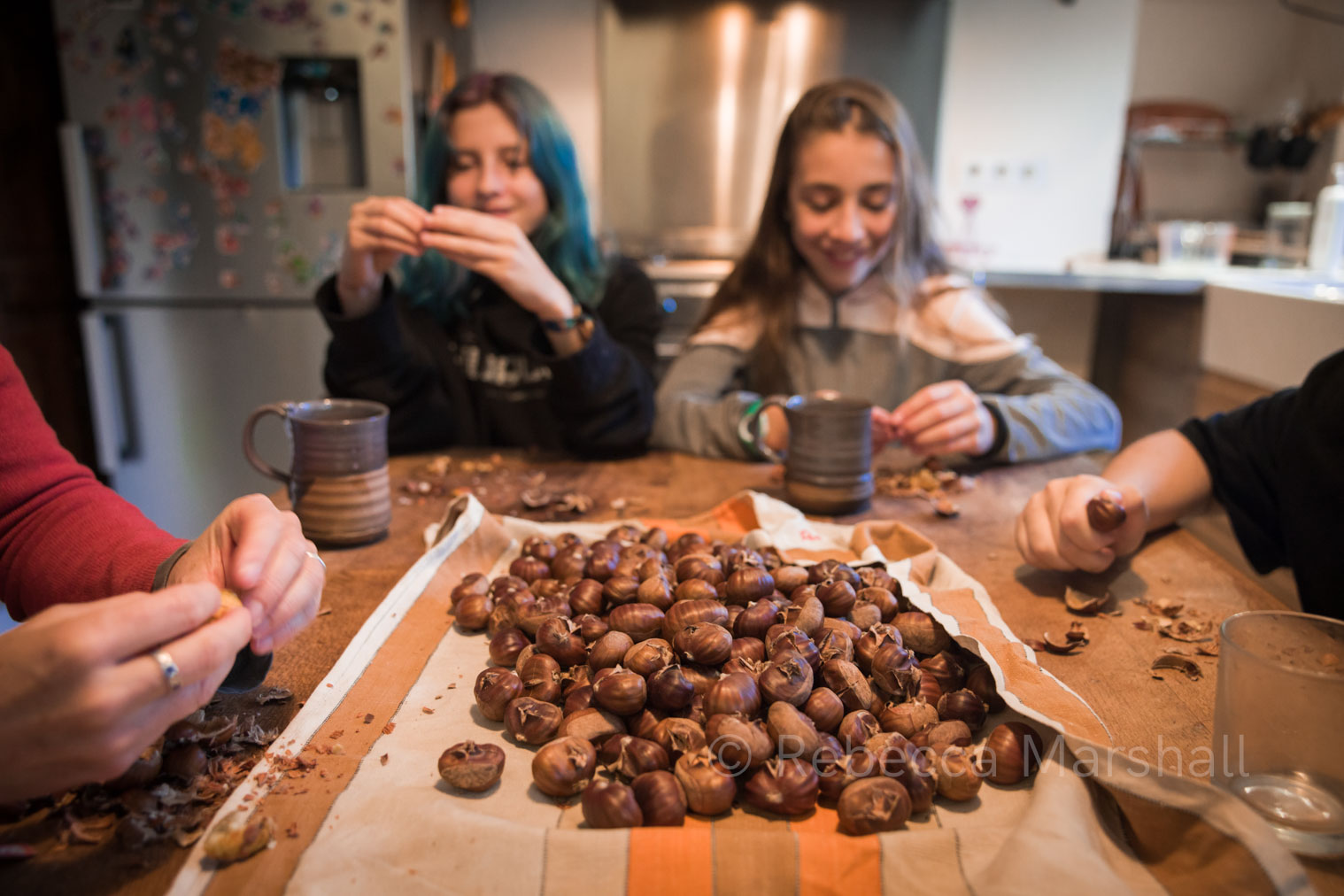
Coline Léger’s customers enjoy a large pile of her sweet chestnuts, oven-roasted
An isolated chestnut woodland
The hinterland above the French Riviera is mostly underlain by limestone – an alkaline environment that sweet chestnut trees can’t tolerate. Annot, a 1.5-hour drive inland from Nice, sits atop a sandstone outcrop. An unusual geological island in the area, it provides an acidic soil that suits these trees. Once upon a time, harvesting chestnuts was a mainstay of the local economy (as the tree on Annot’s coat of arms attests). Chestnut woodland was cared for: scrub was cleared, shoots weakening the trees were cut and new trees planted or grafted with care. Due to the valley’s isolation and a long history of grafting, several distinct local cultivars are found here that do not exist elsewhere. In turn, the trees provided food for both people and animals, as well as material for basket-making, timber and firewood. Chestnut production reached its zenith in the 19th century, the arrival of road and railway enabling the fruits to be sold as far away as Marseille. However, two world wars and a rural exodus left few active people in these communities, and chestnuts were largely forgotten. The trees can live for hundreds of years, their trunks growing to many metres in diameter, in the right conditions. Yet, to thrive as strong, productive trees, chestnuts require year-round maintenance. Without people caring for them, other species -especially ubiquitous Scots pines- moved into the clearings, crowded out the space-loving chestnuts and starved them of light.
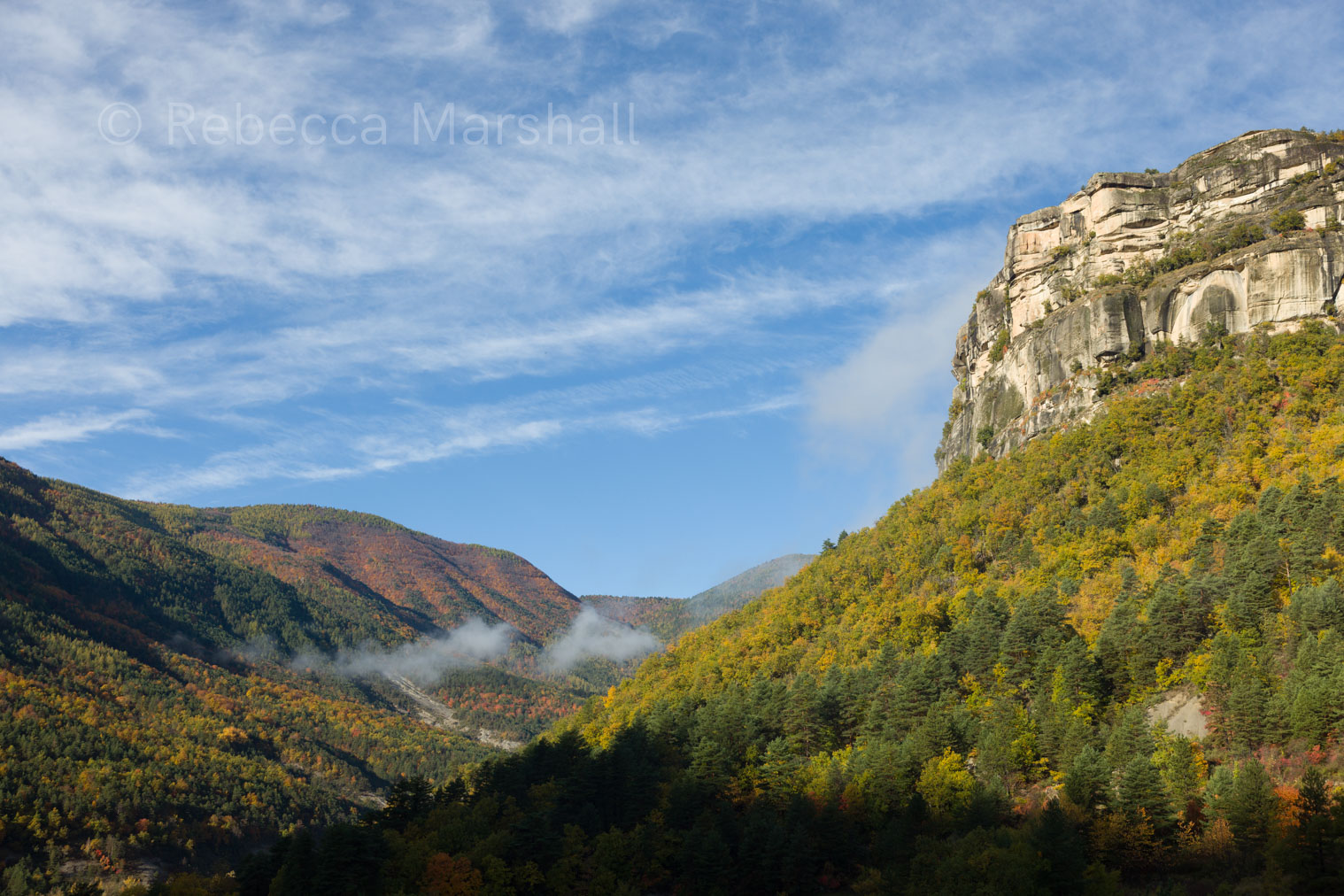
The slopes above Annot are a sweet chestnut tree sanctuary
Green shoots of a new beginning…
When Nadine’s family moved to their farm above Annot 20 years ago, the lone homestead at the end of a 3 km rough track was “an abandoned pile of stones in a jungle”. There were some chestnut trees left, but they were fading fast, and gave few, puny fruits. She and her husband, done with rebuilding the farmhouse, cleared the land around the trees and cut them back – so harshly that it took years for them to bear fruit again. No matter, they had no plans to produce chestnuts.
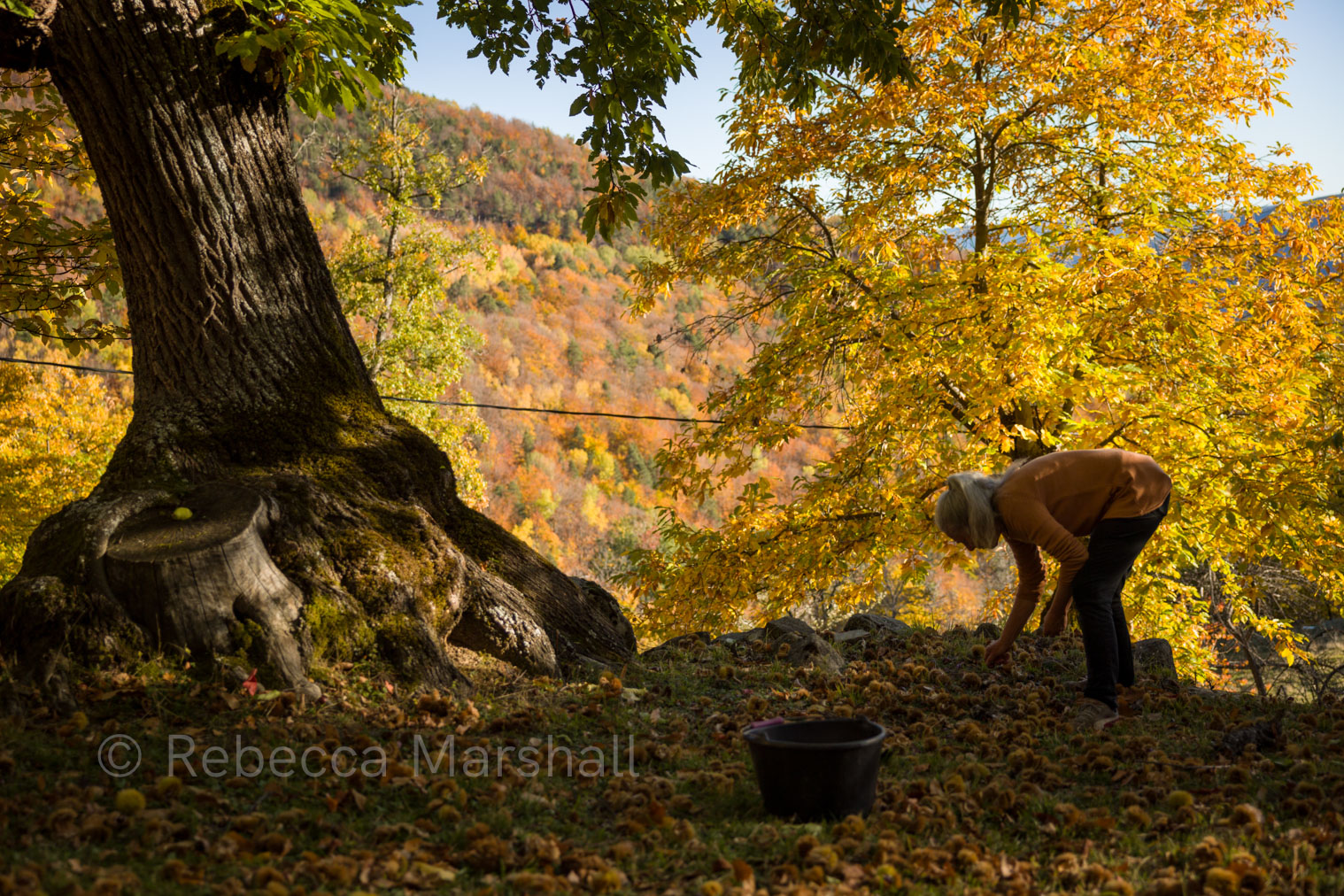
Nadine picks sweet chestnuts under a tree above her farm
Forestry officials at the region’s head office, meanwhile, alarmed by the decline of these native trees and the significant loss of a unique woodland habitat, decided to act. In an effort to save what was left of the chestnut groves, training and grants were offered to incentivise the valley’s landowners, much of whose knowledge had disappeared with earlier generations. Nadine’s husband was now working away during the week, and she was in need of a new project. She decided to sign up. Before long, she felt at ease up a ladder wielding a chainsaw, knew how to graft trees… and eventually began to see her chestnut trees bearing more -and ever sweeter- nuts.
…but what to do with all the nuts?
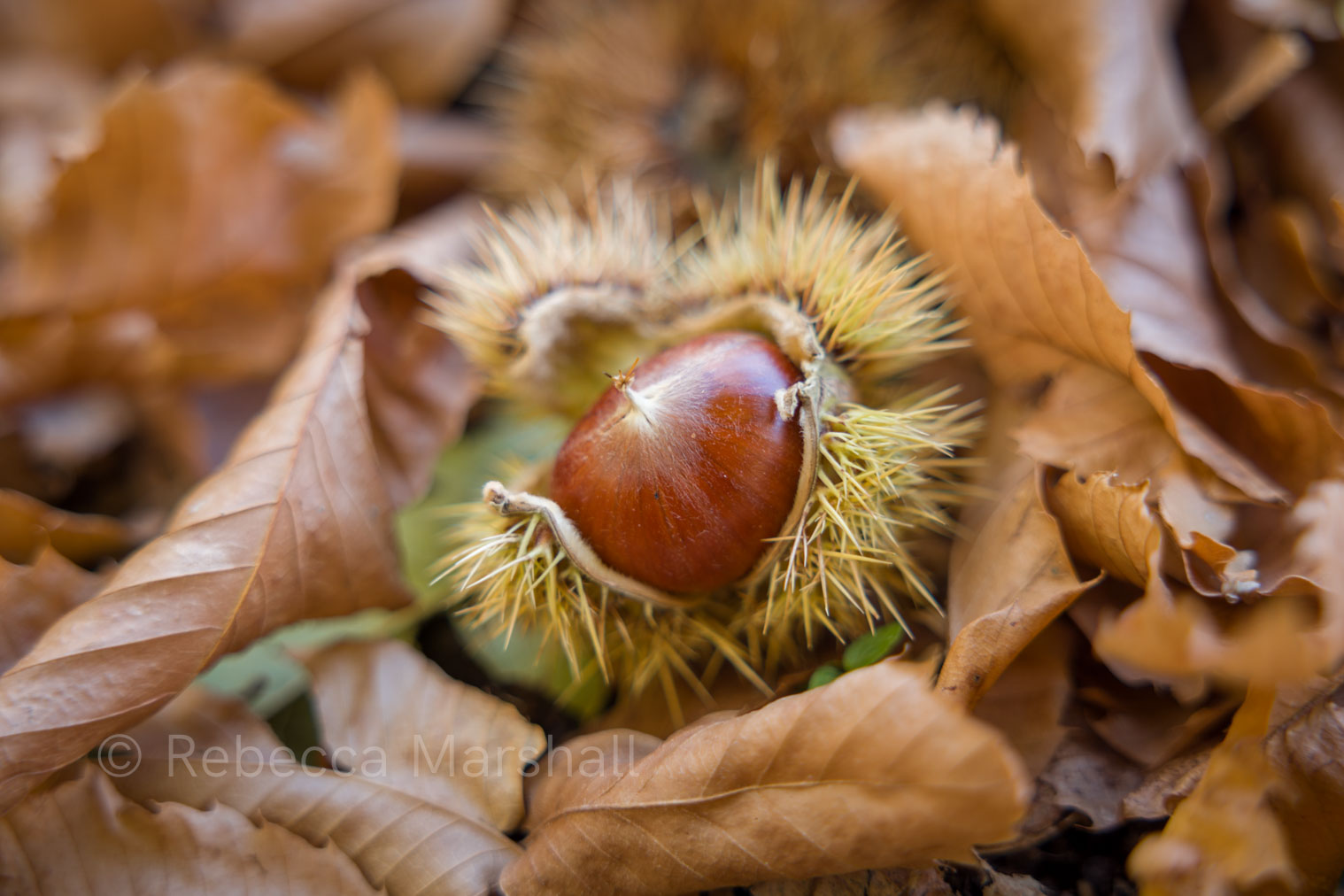
Ripe nuts burst out of their spiny shells across the woodland floor
Yet what was to be done with them all? The project participants sold some chestnuts at the market and doubtless enjoyed a fair few grilling sessions. But the harvest period is short. Fresh chestnuts spoil quickly, even in the fridge, and there is a limit to how many one can eat in a week or two. To handle her dramatically increased yield, Nadine built a little shed, where she cooked and peeled chestnuts by hand, then made small experimental batches of different chestnut preserves. But anyone who has tried peeling a chestnut will know how slow and impractical that is for anything more than a mouthful. The nearest facility with machines that could peel and cook large quantities of chestnuts was a 2-hour drive away. Project members were dropping out fast as the grants came to an end and people simply didn’t know what to do with their harvest.
A community workshop is born
Nadine couldn’t accept that the chestnuts would fall into oubli a second time. She did the rounds of her neighbours, persuading them to put their heads together and find a solution. In 2014, the idea of L’Association Châtaignes des Grès was born, with, at its heart, the concept of a local workshop with facilities to transform the chestnuts into food products that could be stored. The idea did not take off immediately. “Our first challenge was to convince the mayor and town officials that we could make a product that was market-ready.” Nadine and a group of her neighbours took their chestnuts to an established workshop at Génolhac in the Cévennes, one of the biggest chestnut-producing areas in France, to learn from the best. They drove 10 hours there and back, several times over 3 years, testing machines and perfecting their product, before they finally presented the result at Annot’s town hall. After a mayoral dip of fingers into this jar of crème de châtaigne, things changed. More and more local people got on board, seeing the potential local economic benefits of the project, as well as those to the woodland. The town hall officials finally found Nadine and her friends a place to set up a workshop, which opened in 2021.

Crème de chataîgne: delicious, spread on fresh baguette
10 tonnes of fat chestnuts
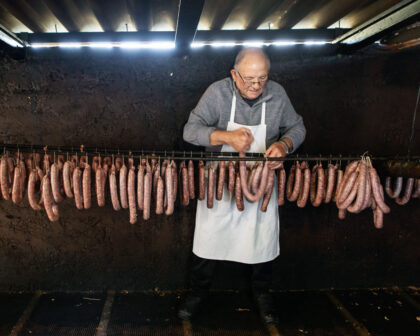
Fast forward to today. It is still early when Coline, Nadine’s daughter, who has taken over the family production, arrives in Annot with 270 kg of freshly-picked and sorted chestnuts in her little van. Manu, the workshop coordinator, had lit the stove to heat water at 6 am and steam rises out of the vats into the cold air. Housed in a former Catholic college refectory, the workshop will this year cross a new threshold, reaching- and exceeding- its full capacity to treat 10 tonnes of chestnuts. With the help of three salaried technicians present, Coline uses the state-of-the-art, small-scale machinery to transform her harvest. The sweet chestnuts are boiled, crushed under high pressure to effortlessly remove their peel, simmered in sugar syrup and pressed through various stages of filters and a centrifuge to extract the sweet pulp, which is then squirted into jars and pasteurised. At the end of the day, she will take home 1,200 jars of crème de châtaigne – fully organic, ready to sell and storable for years, not days. Coline, selling through markets and organic stores in the region, aims to make a living exclusively from chestnuts this year, for the first time.
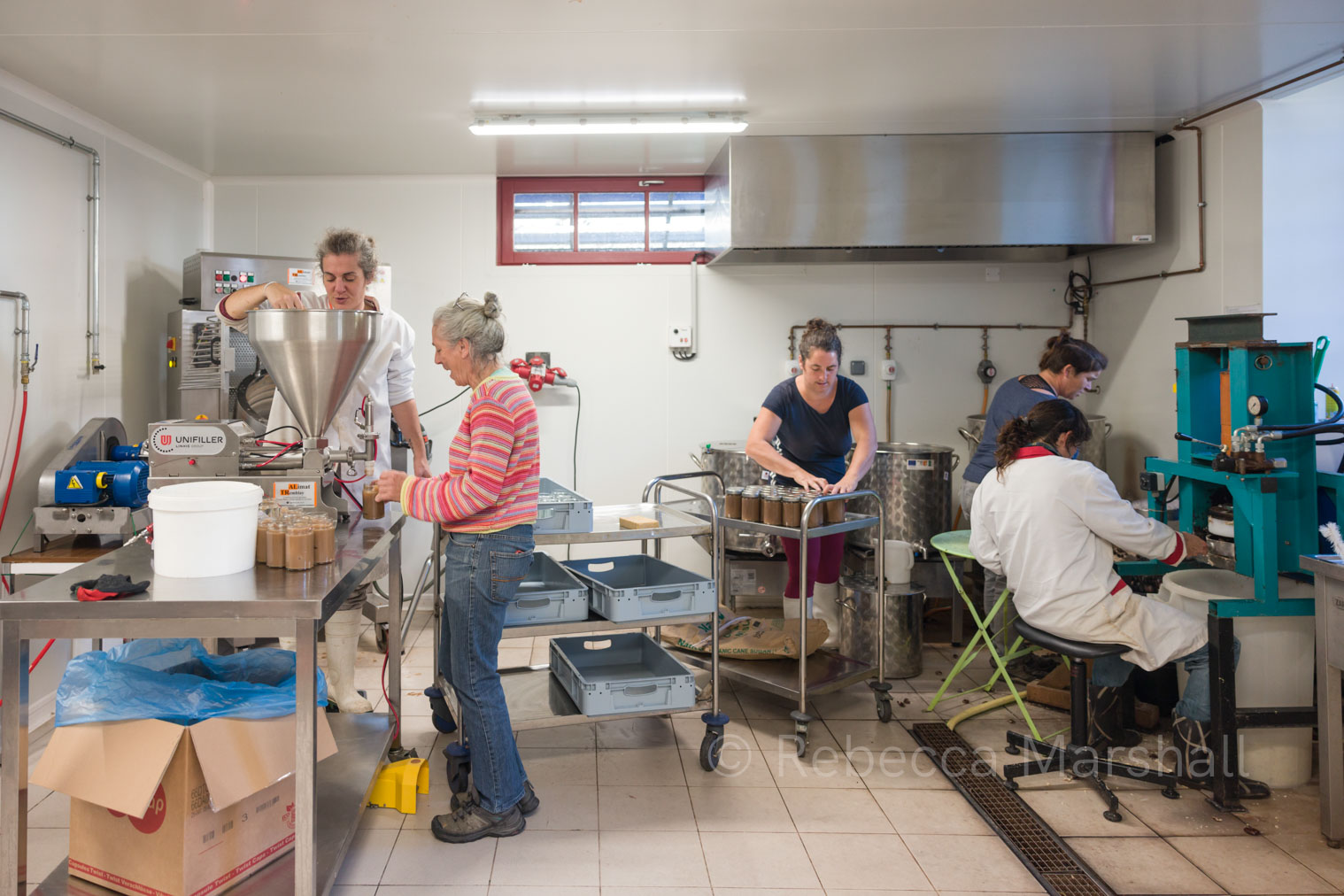
Nadine (second from left), and her daughter Coline (centre) work with colleagues to make chestnut cream
There is no mobile phone network in the atelier and the four women work quietly, in unison, the hissing and bumping of the machines setting a regular background hum. They take their lunch break as a batch of chestnuts is simmering in syrup, heading upstairs to a little dining area with windows looking over the mountains above to eat together. Sitting around shared plates piled with Provence-cured ham, ravioli and pissaladière, talk flows easily. Asked whether they remember harvesting chestnuts as children around Annot, technician Géraldine smiles: “When I was little, we never even ate what we found in the woods round here! The few chestnuts we collected were so tiny it just wasn’t worth the effort of peeling them.” They all agree that things have certainly changed. “Just look at the size and quality of what we have coming through here today!”
Interest from all corners of France
The workshop is fully self-sufficient now, with four paid employees. During the few weeks of the season that it is open, the atelier services no less than 64 local producers who, like Coline, book sessions to come and transform their chestnut harvest into crème de châtaigne or stewed chestnuts, paying a per-pot fee to do so. Sales of their products, either from the Sunday-only, volunteer-manned shop at the side of the building, or through outlets across the French Riviera, have helped to rejuvenate the local economy – chestnuts are finally doing justice again to Annot’s coat of arms.
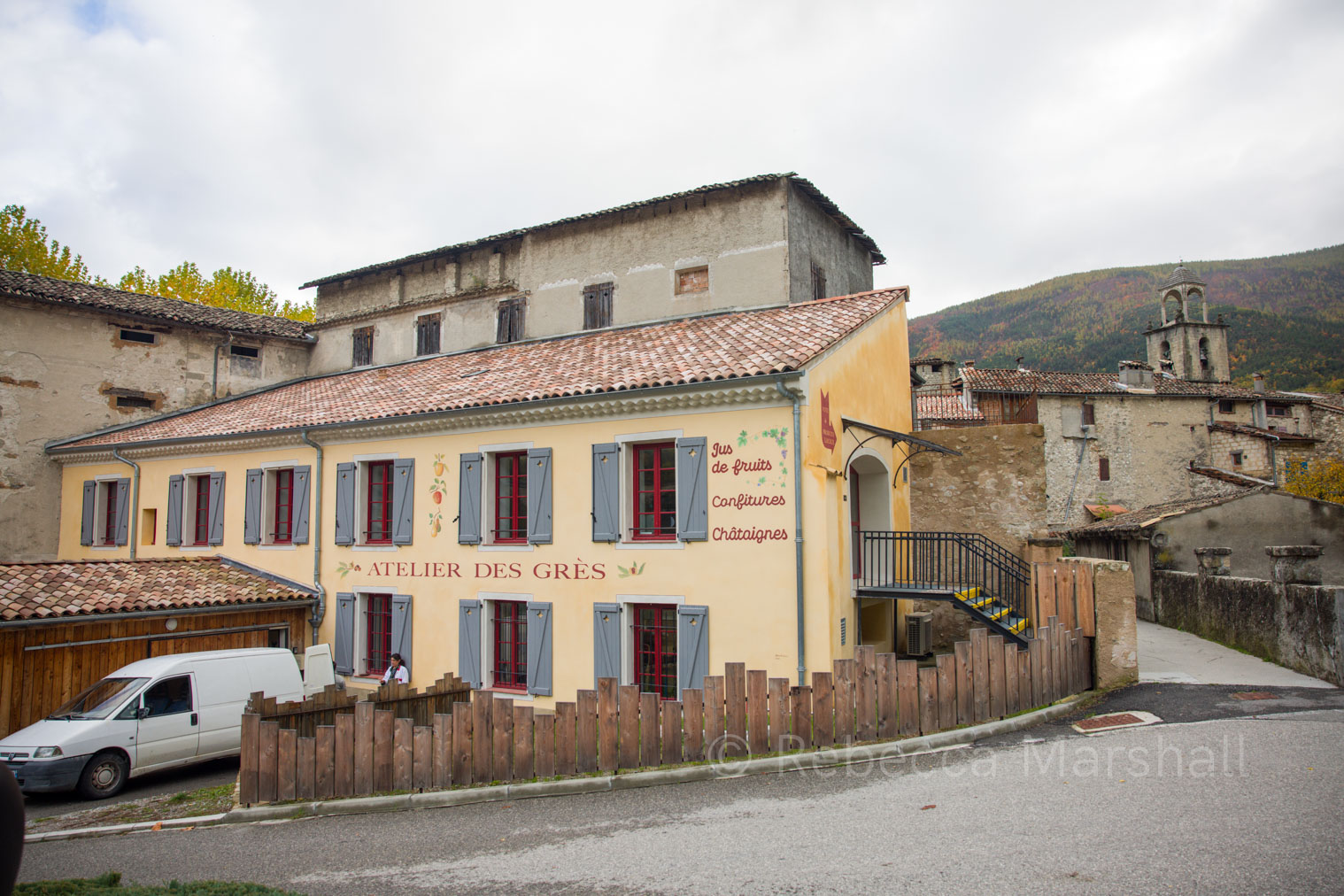
The Atelier des Grès, in the heart of the village of Annot
“We’ve got more demand from producers than we can handle for the first time this year, and people coming even from as far away as Brittany and Corsica to learn about our model too – we may need to start working nights!” says Manu enthusiastically. ”We’ve been testing freeze-drying of chestnuts, and I would love to look at introducing chestnut flour in the future.”
A reluctant hero
Regardless of the number of people now involved, everyone seems to concur that without Nadine, her determination and early leadership, none of this would’ve happened. Yet she remains a reluctant hero. Back on the farm, the sun is starting to set and she pauses in her picking to gaze down over the valley below. “I don’t take credit for this project. We all did it. It’s only through helping each other and working together that humanity stands a chance”
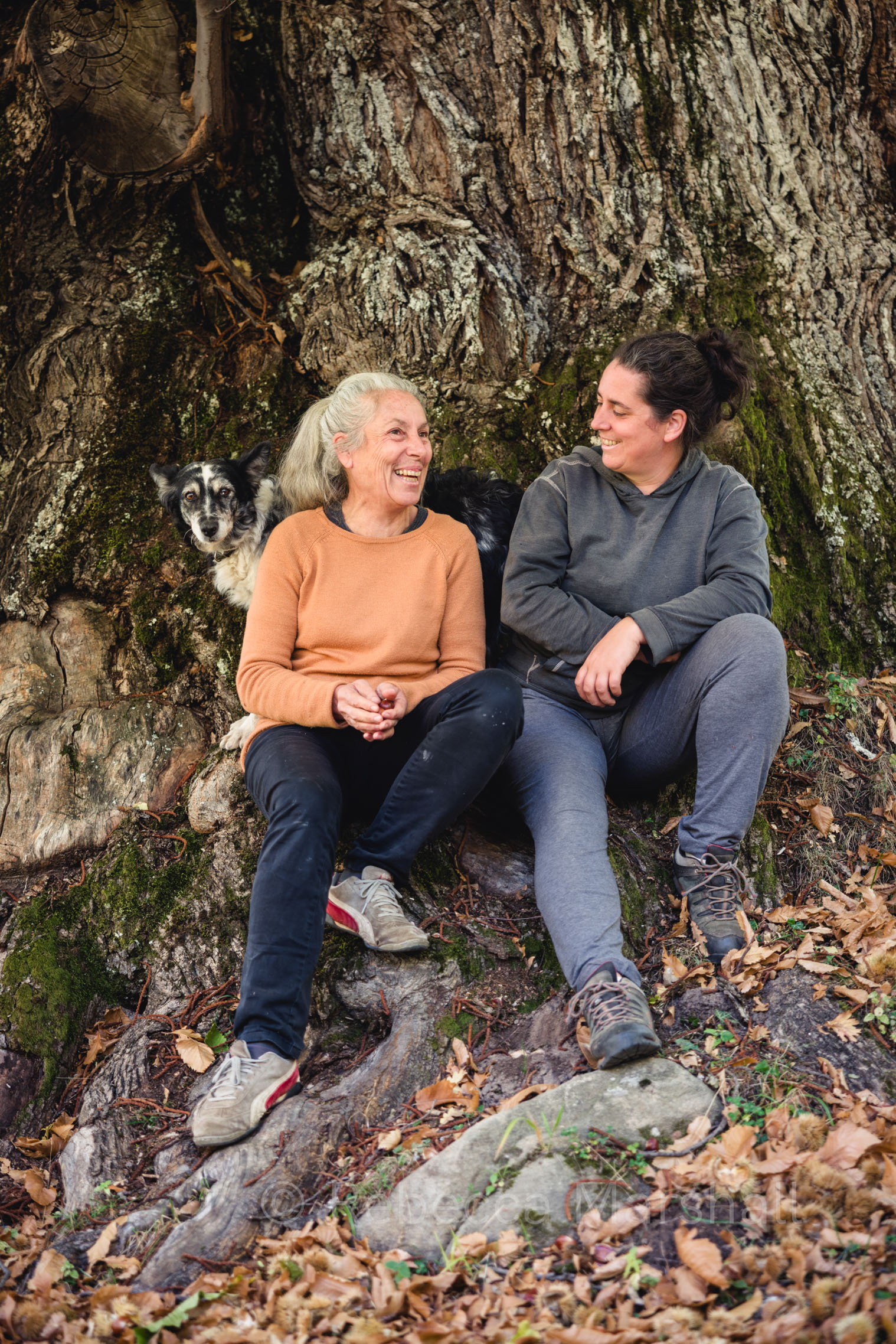
Nadine and her daughter Coline sit under the ancestor tree
The trees don’t have much to say either, although they certainly look in fine form. Nadine walks up to a particularly magnificent large sweet chestnut, above her farmhouse. On a closer look, small urns have been placed in crevices halfway up the trunk. “I like to think of this as the ancestor tree. What better place for the soul of our parents to reside than in a giant chestnut tree?” Just as the memory of those who once planted the groves is safe in the tree, so the future once again looks secure for the sweet chestnut trees of Annot.
The words and photographs of this reportage in Annot (autumn 2025), were published as a seven-page feature in the current issue of Leven in Frankrijk & Frankreich Magazin [Nov-Dec 2026].
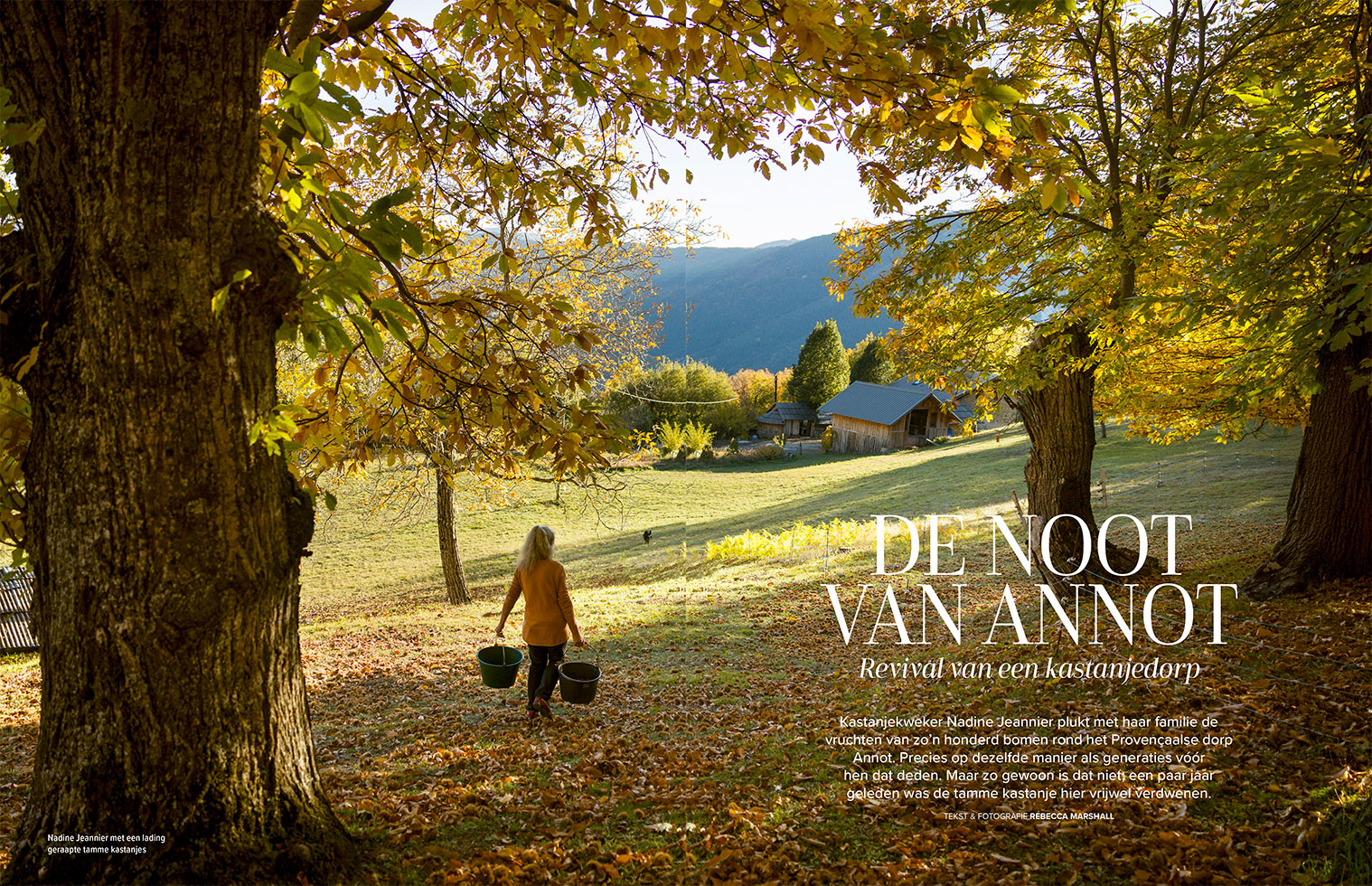
‘The Nuts of Annot’
> See Reportage portfolio