“As we grow older, people tend to think ‘Don’t challenge yourself, make it easy’. But I think making it easy is why people fall apart.” (Pauline Fry)
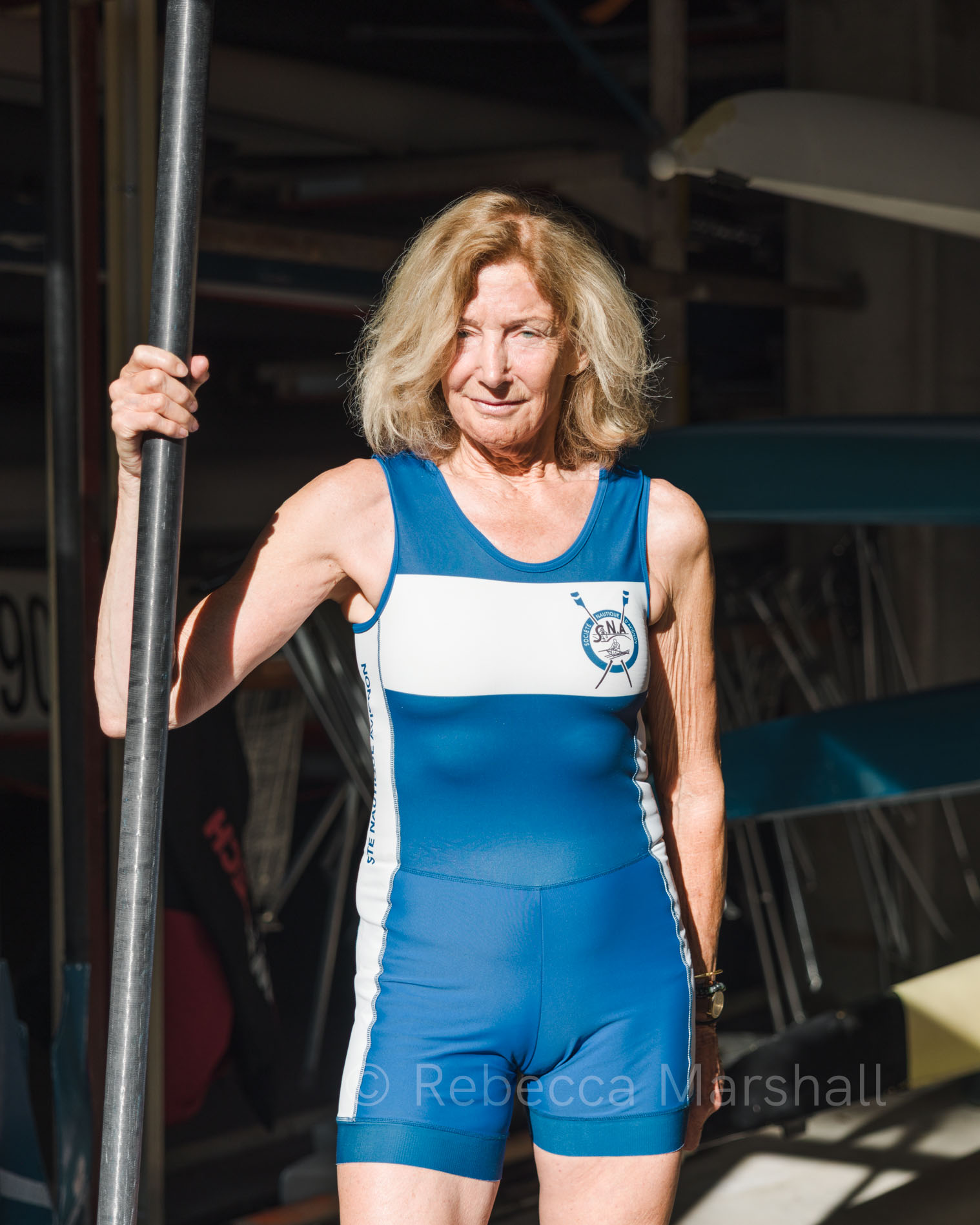
Pauline Fry, 80 years old and not looking it
The French Riviera attracts retirees from far and wide. Silver-haired sun-lovers slide towards their dotage here, seeking respite from arthritis in the warm, dry climate; elderly friends sit under plane trees, nostalgically watching pétanque games as they discuss health woes; rubber-bonneted grannies rise at dawn to slow-walk in the safe shallows of the Mediterranean to keep flagging circulation under control. The South of France offers the dream of a best-case old-age scenario.
Pauline Fry, however, presents a different possibility for life’s last chapter. She doesn’t have much time for sitting around as she is too busy training… for one of the most physically demanding sports there is. Pauline turned 80 this summer – and she also won a medal at Henley as a competitive rower. I was commissioned by the Daily Telegraph to make her portrait and travelled west from the Côte d’Azur to Avignon, her adopted home. We met early one morning at the Société Nautique d’Avignon, the rowing club of which she has been a member for 15 years. The sun was set to be fierce later that day, but for now the light was soft and the river empty.
Pauline arrived: a petite, slight figure, with clear blue eyes that radiated energy and intelligence. She hadn’t been keen to work with a photographer, telling me at the start of what she hoped would be a very brief photoshoot that she hates having her picture taken. I’d seen a ray of sunshine illuminating the entrance to the boat garage, and asked her for a portrait there. “Oh gosh no, don’t do a full body shot, I mean honestly, no-one wants to see that!” I looked at her, statuesque and strong with oar in hand, her lycra-clad form outlining abs and arm muscles that I don’t have, and begged to differ. She rows on the river 3 times a week and works out at the gym, on a rowing machine and with weights, the rest of the time. She was matter-of-fact about the effort: “It’s harder to stay fit when you’re older – you do fewer reps but need to lift heavier weights to build muscle.”
Life less ordinary
Ignoring conventional expectations of how life should be lived is not new for Pauline. Studying for a Master’s in literature in her birth country, the US, she hadn’t yet graduated before stepping outside the tracks, marrying her professor at the tender age of 20 – and divorcing at 23. She initially then disappointed any hope of applying her studies to her career by choosing to work at a ski station, then heading to Europe on a plan-free whim. She never left. After a patchwork of random jobs, including a stint working at a soul food restaurant in Paris, she eventually did put her degrees to use – in an unlikely form. She found herself a rather obscure niche “introducing GIs to Oscar Wilde” [teaching military students posted abroad through the University of Maryland’s European division] and she lived in Crete, among other locations, always close to military bases. She later taught literature at the American University in Rome, and led writing courses for expatriates.
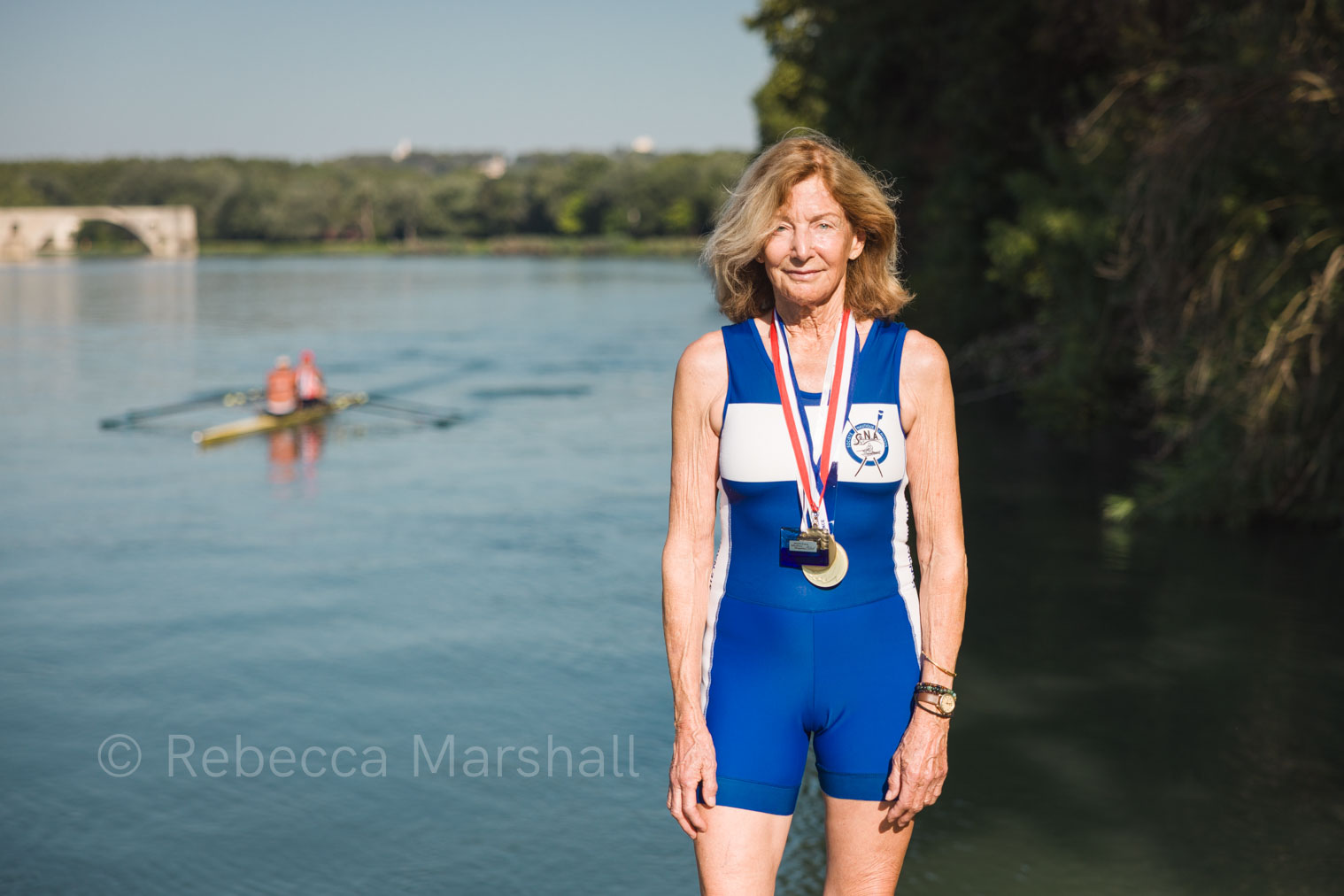
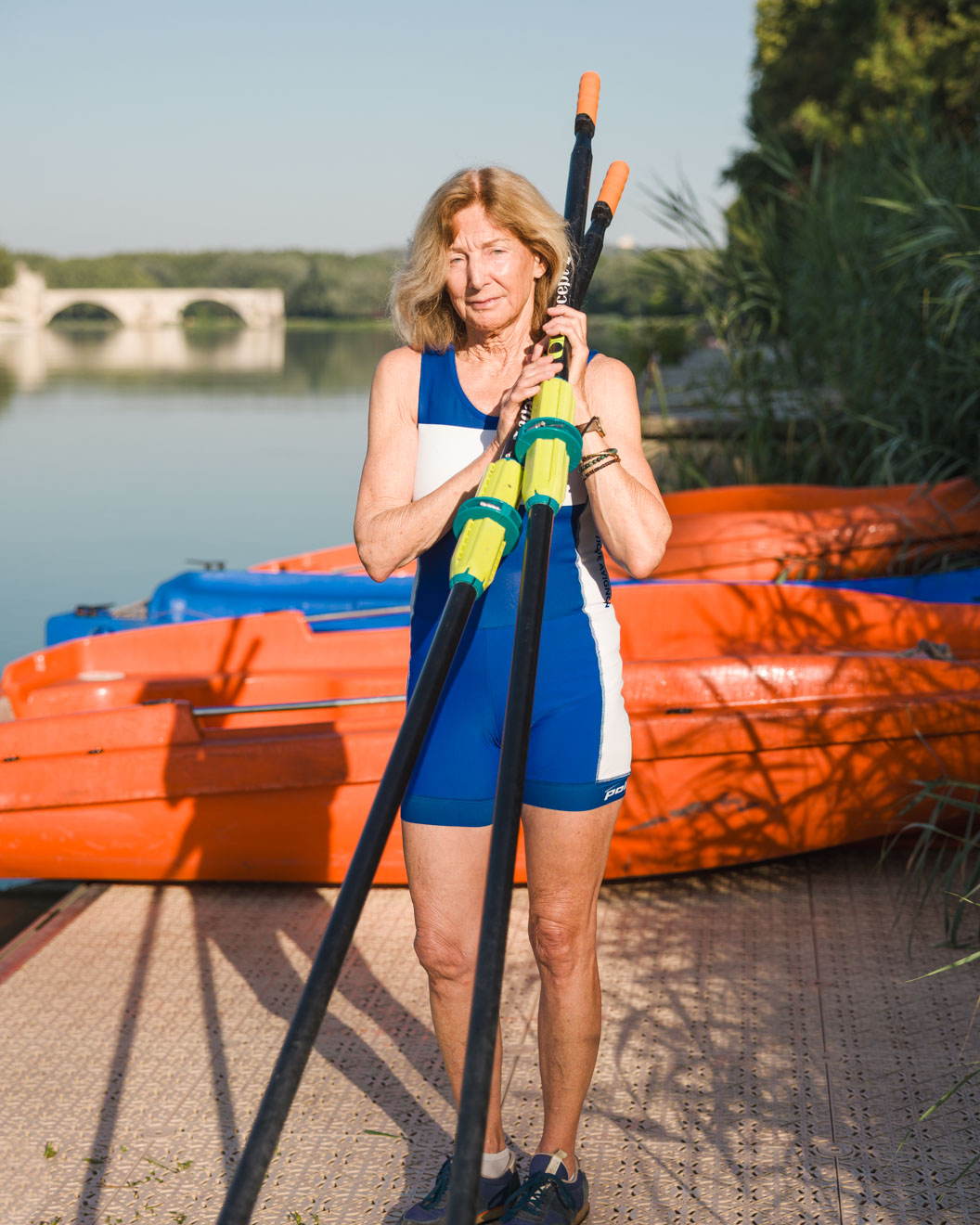
Pauline trains in view of the Pont d’Avignon three times a week
Pauline’s second marriage, to a German biochemist, was as successful and long-lasting a union as her first was not – even the story of their meeting oozed 19th-century romanticism: “I met Franz, a stunning man in a white suit, in a ray of sunlight in the Sistine Chapel. Our first moments were overseen by Michelangelo’s Adam.” When Franz passed away 14 years ago, it was a catastrophe for her. “I basically collapsed, mentally and physically. I detached a retina in my eye, broke my shoulder, then my wrist. I was a wreck.” As time passed, she felt she had a decision to make: either stop living, in a sense – or start a new life. She chose the latter. Pauline upped sticks and left Rome and the empty spaces that Franz no longer inhabited. She moved not just to another city, but to another country, relocating to France – a small village close to Avignon. Learning French and integrating into local life became her project… and rowing was her bridge to a new community.
Broad in a boat
I suggested making photographs of Pauline on the water and a rowing club colleague quickly stepped in to help her carry out the boat. A young amateur cox hung on her words as she warmly introduced him, describing his budding talent. Schoolchildren were arriving for a summer rowing workshop and she had volunteered to help teach them the ropes. Pauline was clearly something of a doyenne: the oldest member of the club, and a respected one. “The guys sometimes invite me onto their boat to make up their team – it’s nice that they ask,” she humbly said. Yet both of us know the Southern European brand of macho – this is not a token of kindness. They want her in the boat because she’s good, and can perform better than a less experienced, younger man.
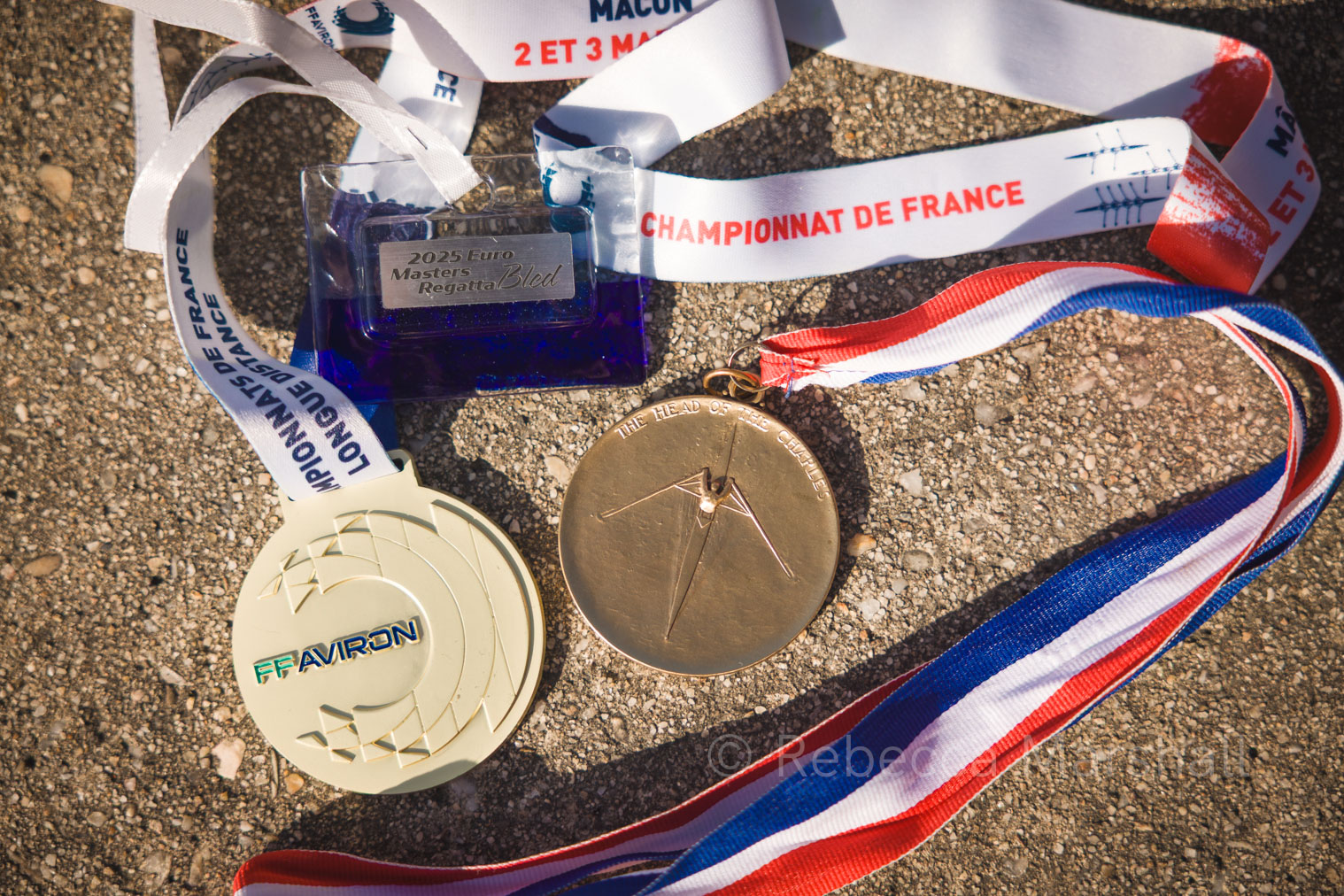
A small selection of the medals Pauline has won over recent years
The medals Pauline had brought, as requested, to the photoshoot represented a small selection of the dozens she has won: from national Italian titles to European medals and a silver international medal that she won only 4 years ago in the World Masters Championships. A few weeks later, she was due to race for the first time at Henley, in the Masters Regatta. Pauline had never rowed with the other members of her quad before – one, an amateur rower of 92 years – and they would practice just twice before the race. Yet Pauline didn’t seem fazed. “It’s a dream for me!” she said, joyfully.
Late, stuttering start
Given her record, I assumed that Pauline had been a lifetime rower, so was surprised to learn that she had taken up the sport at the age of 50. Her love affair with rowing began in Rome and – in a life lesson about the value of persisting rather than expecting a new skill to come naturally – her learning curve was steep. “When I did my first race eventually, in Seville, I came last… and I was thrilled! Simply to have completed it!” She laughed at herself as she described her first attempts, rowing alone on the Tiber, thinking she was doing pretty well – and then the reaction she got when she dared to ask a prominent coach for lessons. She fondly remembered how the wonderfully-named Orlando Parmagiano (a former international rower and coach) had, when she approached him, lowered his glasses and asked: “You want Me to give You lessons?! The boat assassin?!” Despite his belittling comments on her rowing style, she persuaded him to take her on. She said he taught her everything, and praised both the mastery and the poetry he brought to the task.
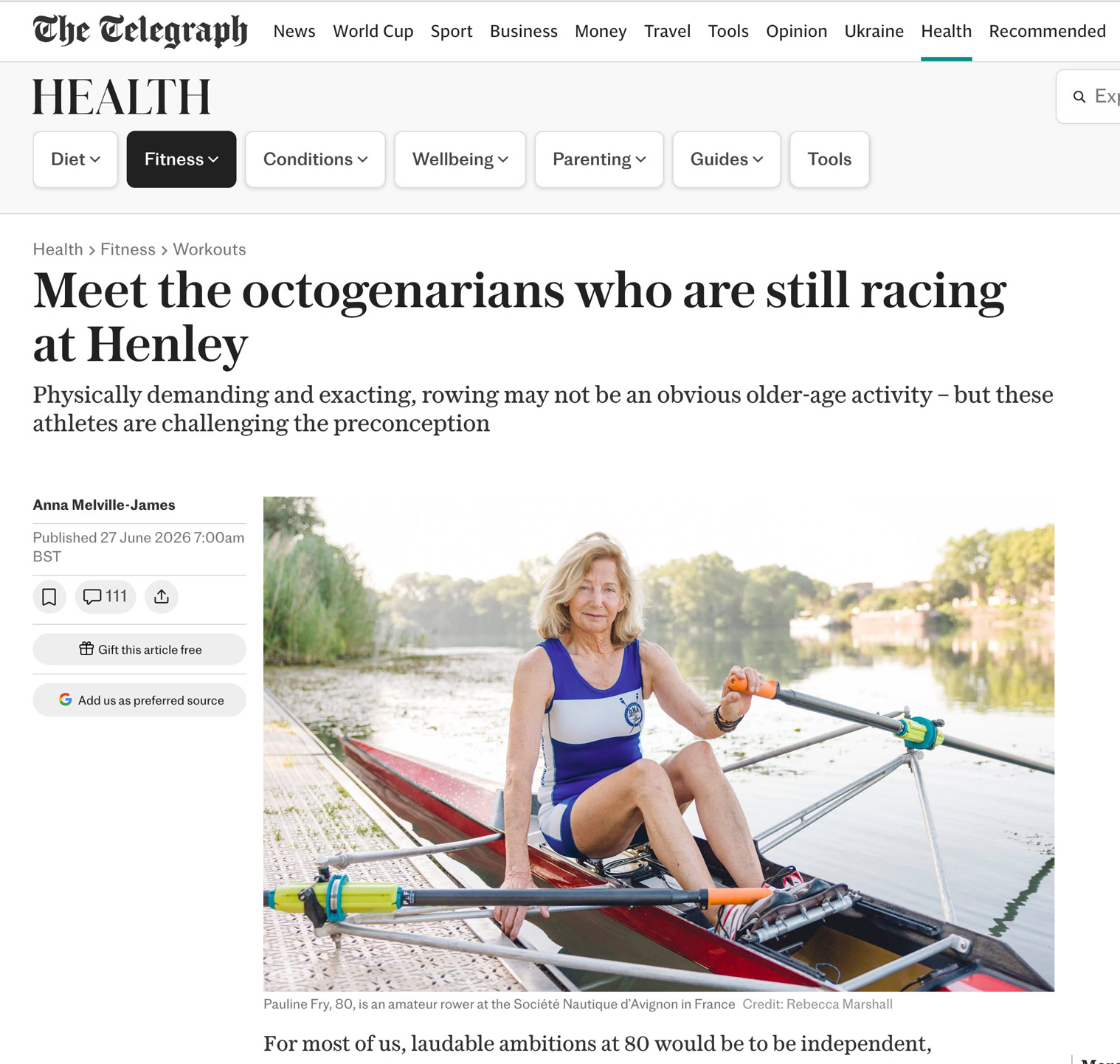
Daily Telegraph feature portrait
Life in the present tense
By now, the sun was high and the silken surface of the Rhône was breaking up into wavelets, disrupting reflections of the Pont d’Avignon downstream. Pauline told me she would need to return home soon – it was her shift at the communal village chicken coop, and the hens would need to be let out before it got too hot. I helped her carry her single scull back to the boathouse – at 15 kg, it was incredibly light, but its length would’ve made it challenging for anyone to handle alone.
Later, she had friends coming to stay, an article to finish for the local newspaper that she writes for, and then she would be flying to Paris for a few days. What, I wondered, made her so active and engaged in life, when so many people of her age are not? “I’m grateful every single day for what I have,” she began, and then thoughtfully added: “I’m curious, too. Since I retired, I have the space to discover the things I’ve always been curious about. Why stop or slow down? I’m going to do as much as I can – until I can’t. I live in the present tense.”
Bringing it home from Henley
Last week, I received a short email from Pauline. Her words made my day: “Just thought I’d keep you up to date. We won at Henley! I just Loved rowing down that epic course!”
For many of us, our best hopes for old age are that we keep our marbles, remain relatively pain-free and stay modestly mobile for as long as we can. Pauline’s attitude, her fitness, curiosity and enthusiasm challenge the limitations of that goal. In a world where interesting female role models of the third age are arguably lacking, she shines a bright light on the path up ahead.
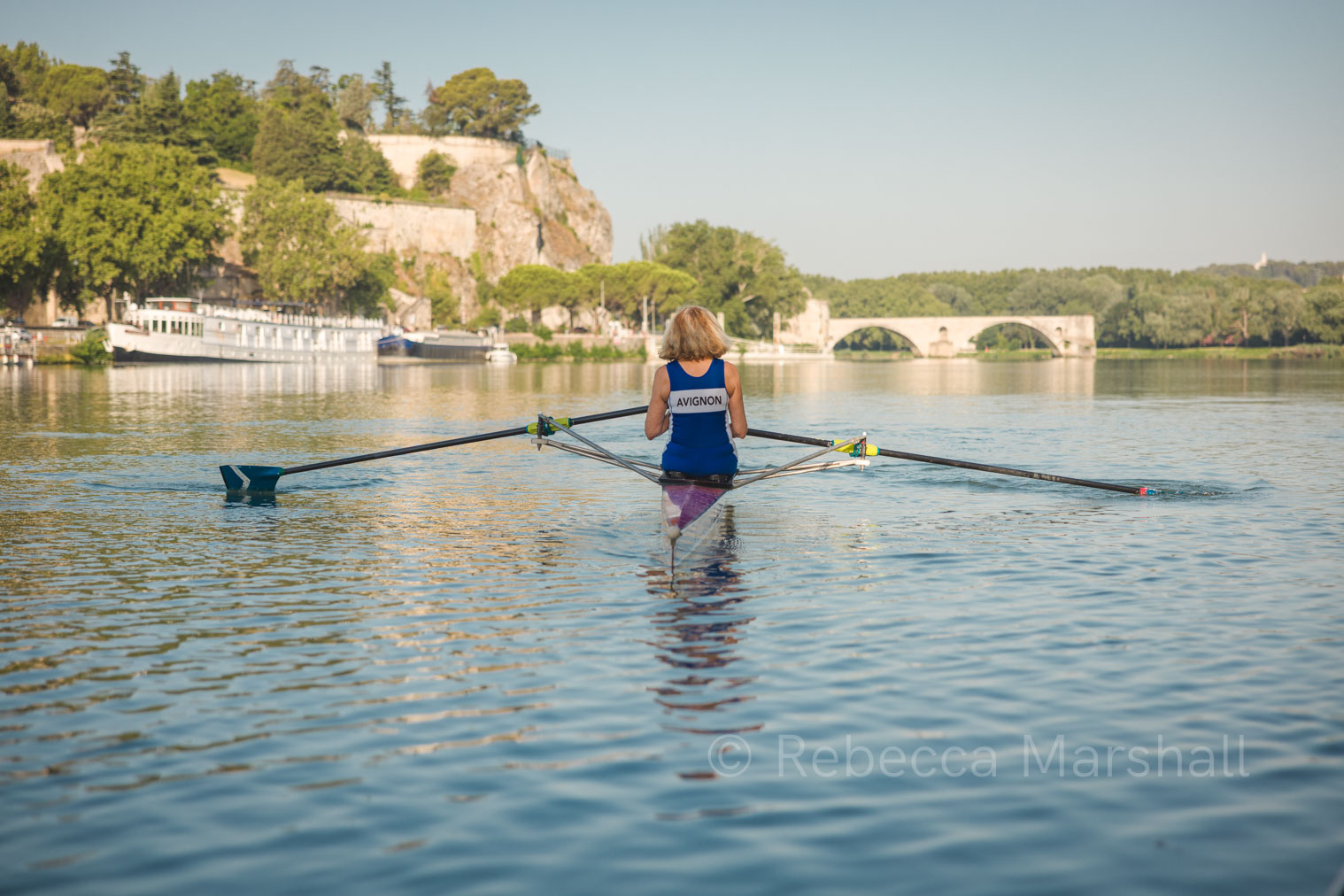
“Why stop or slow down? I’m going to do as much as I can – until I can’t.”
> See Portrait portfolio